

How to Tell If You Have Termites: Early Signs, Damage Clues, and What to Do Next
Signs of Termites in the House
Termite damage rarely looks like much at first — a faint hollow sound when you tap a baseboard, a door that started sticking last spring, a faint smear of what looks like sawdust under a window frame. These are the kinds of things homeowners rationalize away. Taken together, they’re the story of a colony that has been feeding, silently, for years.
Knowing how to tell if you have termites before visible structural damage appears is the difference between a few hundred dollars and a five-figure repair bill. This guide covers the termite damage signs in a house that matter most, where to find them, and what to do when you do.
Why Termites Are Hard to Detect
Termites are called silent destroyers because they work out of sight. Unlike ants or cockroaches, they almost never travel on open surfaces. Instead, they feed inside wood, leaving the outer shell intact; build sealed mud tubes to stay concealed and retain moisture; and live in soil or deep within structural cavities. A mature eastern subterranean termite colony — the dominant species in New England—can contain hundreds of thousands of workers operating around the clock.
By the time visible damage appears, the infestation is usually well established. That’s the core problem: the signs you can see are often lagging indicators, not early warnings.
What Are Termites, and Which Species Should New England Homeowners Know?
Termites feed on cellulose — the organic fiber found in wood, paper, and plant matter. In New England, the species responsible for the vast majority of structural damage is the eastern subterranean termite (Reticulitermes flavipes), a ground-dwelling insect that forages through soil and requires moisture to survive.
A second species, the drywood termite, occasionally appears in the region — typically introduced through infested furniture or lumber — but is far less common.
| Feature | Subterranean Termites | Drywood Termites |
| Entry point | Soil contact, foundation cracks | Wood-to-wood contact, structural gaps |
| Key evidence | Mud tubes, hollow wood, swarmers | Frass (pellet droppings), swarmers |
| Common in New England? | Yes — primary species | Rare, but possible |
| Moisture needed? | Yes | No |
5 Termite Infestation Signs to Look For Right Now
1. Mud Tubes on Walls or Foundations
Mud tubes are the most reliable early indicator of subterranean termite activity. These pencil-thin tunnels — roughly the diameter of a drinking straw — are constructed from soil, saliva, and termite droppings. They run along foundation walls, crawl space piers, concrete blocks, and anywhere wood meets the ground. Their function is practical: they maintain the moisture and darkness subterranean termites require while shielding workers from predators and open air.
Check your crawl space, the base of your foundation, pipes entering the structure, and wherever wooden framing meets concrete. Even a single intact tube is a strong indicator of active movement. If you break one open and find live workers inside, that colony is feeding right now.
A note on testing: breaking a tube is a detection method, not a fix. Mark the location, check back in 24–72 hours, and if the tube has been rebuilt, the colony is active. Call a professional at that point — rerouting is what colonies do when disturbed.
2. Hollow-Sounding Wood
Termites consume wood from the inside, leaving only a thin shell on the surface. Tap on suspected framing, baseboards, windowsills, or door frames — solid wood produces a dense thud; termite-damaged wood sounds like a drum. You can probe further with a flathead screwdriver: if it sinks into wood that should be firm, the structure is compromised.
In older New England homes with balloon-frame construction, this test is especially worth running inside closets, around stair stringers, and along walls adjacent to soil-grade foundation areas. Hollow sound combined with small pinhole entry points or sunken grain on the surface is a composite sign that should not be ignored.
3. Discarded Wings Near Windows and Doors
Each spring, mature subterranean colonies release swarmers — winged reproductive termites whose job is to leave the parent colony and establish new ones. These alates are drawn toward light, so they congregate near windows and sliding glass doors. Shortly after landing, they shed their wings, which is why you’ll often find small uniform piles of translucent wings on windowsills, in door tracks, on light fixtures, or caught in spider webs.
Discarded wings carry a specific message: a mature colony is nearby, and new colonies may now be forming inside or immediately adjacent to your home. If you’re finding wings indoors, the source colony is almost certainly already established within your home’s footprint.
Common confusion: flying ants look similar to termite swarmers at a glance, but the difference is diagnostic. Termite swarmers have straight antennae, a uniform body width, and two pairs of wings of equal length. Flying ants have bent (elbowed) antennae, a pinched waist, and unequal wing pairs. Misidentifying swarmers as ants can delay treatment by an entire season.
4. Frass Droppings (Termite Waste)
Frass is the calling card of drywood termites. Unlike subterranean termites, drywood termites push their waste out of small kick-out holes in infested wood, creating tiny piles of pellet-shaped frass droppings beneath infested areas — below window framing, near attic beams, or on shelving adjacent to wood. The deposits look remarkably like fine sawdust or ground black pepper.
If you’re sweeping up what looks like sawdust in an area where no work has been done, take a closer look. Frass pellets are hexagonal in shape under magnification, which distinguishes them from rough wood shavings. While less common than mud tubes in New England, drywood termites can be introduced through infested furniture or lumber, so frass shouldn’t be ruled out.
5. Structural Changes: Sticking Doors, Sagging Floors, Bubbling Paint
These symptoms are easy to attribute to moisture, age, or settling — and that’s precisely what makes them dangerous. Termites feeding inside wall framing and subfloor systems disrupt the structural geometry of a home. As wood fibers are consumed, affected elements lose rigidity: floors begin to sag, doors and windows stick in their frames, and surface finishes bubble or peel.
Bubbling paint is a particularly useful indicator. Unlike moisture-driven paint failure, termite-related bubbling tends to occur away from known leak points — on interior walls, baseboards, or wood trim near the foundation. The moisture termites produce while feeding creates a micro-environment just beneath the surface that lifts paint off the wood underneath.
None of these structural symptoms is definitive on its own. Combined with any of the signs above, they matter.
Early Signs of Termites: Why Detection Timing Matters
Termites cause significant structural damage annually across the U.S. — $5 billion in property damage per year, according to Consumer Reports citing the National Pest Management Association. The financial exposure for individual homeowners is just as real: the average homeowner facing active damage spends roughly $3,000 on repairs, a figure that climbs sharply when structural elements like sill plates, floor joists, or support beams are involved. Repair costs can reach $35,000 or more in severe structural cases, well above what most homeowners anticipate when they first notice a problem.
What makes this worse is that standard homeowners’ insurance policies explicitly exclude termite damage, classifying it as a preventable maintenance issue rather than a covered loss. That means the entire cost sits with the homeowner.
New England presents a particularly high-risk environment. The region’s older housing stock, crawl spaces, and significant seasonal moisture create ideal conditions for eastern subterranean termites. At Griggs & Browne, our technicians regularly inspect properties in Southeastern Massachusetts, Cape Cod, Rhode Island, and Connecticut where colonies have gone undetected for three to five years — long enough to compromise sill plates, floor joists, and support beams.
The most expensive termite damage we see isn’t caused by termites — it’s caused by waiting. By the time a homeowner notices something is wrong, the colony has usually been feeding for years.
The practical upside: catching the early signs of termites in year one is far less expensive than discovering a mature infestation in year four. Annual inspections cost a fraction of what remediation and structural repair cost, and they are the only reliable way to find activity in crawl spaces, wall cavities, and other areas homeowners can’t easily access.
Common Mistakes When Looking for Termites
Breaking a mud tube and assuming the problem is resolved.
Homeowners who find a tube sometimes break it and check back later; if it isn’t rebuilt, they assume the termites have moved on. In reality, an undisturbed colony will simply reroute. Rebuilt tubes within a few days confirm active infestation. Absence of rebuilding doesn’t confirm the colony has left.
Treating visible damage without addressing the colony.
Retail spot-treatments may eliminate the termites you can see, but the foraging colony — which may be located many feet away in the soil — keeps feeding. Without eliminating the source, visible damage will recur. This is why whole-colony elimination systems, like baiting technology, are more effective than surface treatments alone.
Only inspecting wood you can see.
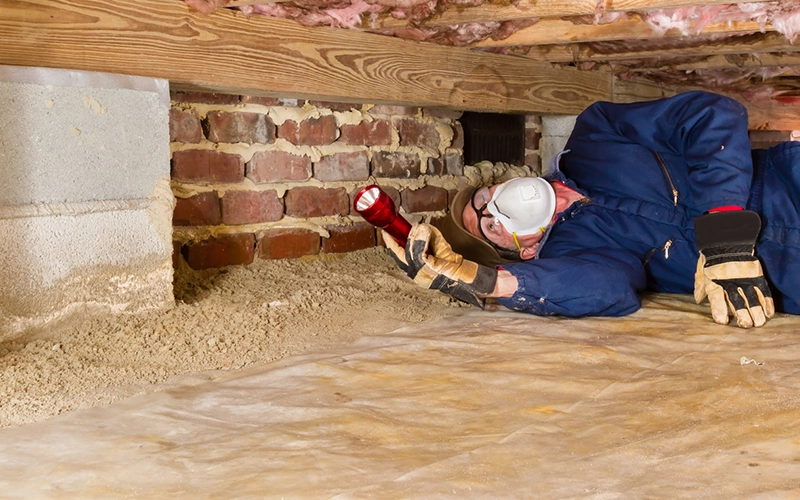
Most termite damage in New England homes occurs in the crawl space — sill plates, floor joists, and band boards that are out of sight and rarely checked. A professional termite inspection covers the areas homeowners can’t easily access, and catches activity before it migrates upward into the living structure.
What Termite Treatment Costs — and What Affects the Price
Treatment costs vary based on property size, treatment method, and infestation severity. Colony elimination baiting systems — such as the Sentricon™ Always Active™ system Griggs & Browne installs — provide ongoing protection through in-ground stations placed around the structure’s perimeter. Annual monitoring plans typically run a few hundred dollars per year, which is substantially less than the cost of responding to active structural damage.
Repair costs are where the numbers climb. Replacing compromised sill plates, floor joists, or support beams can push total costs well beyond the initial treatment investment. Homes with a history of termite damage also typically sell at a discount compared to comparable unaffected properties, creating an equity impact that outlasts the immediate repair bill.
The most important cost-control variable is time.
Frequently Asked Questions
Swarmer season in New England runs from late March through June, peaking on warm, humid days following rain. Colonies release winged reproductives during this window — a visible sign of activity. If you notice insects emerging from walls, floors, or the foundation in spring, treat it as urgent.
Yes. Eastern subterranean termites don’t die in winter; they move deeper into the soil and become less active. When temperatures rise, they resume foraging. An infestation found in summer has almost certainly been present through prior winters.
An active tube feels slightly moist and firm, like damp clay. An older tube crumbles easily and is dry to the touch. Pressing into a tube and finding moist soil particles suggests recent activity. Live termites inside confirm it.
Not on its own — wood can sound hollow from moisture damage, rot, or structural voids. But combined with mud tubes, discarded wings, or sticking doors, the likelihood increases significantly.
No. Many infestations are hidden in crawl spaces, sill plates, or wall cavities with no visible interior evidence at all. Professional inspections — including crawl space access — are essential even when nothing appears wrong indoors.
Check the waist and wings. Termite swarmers have a straight body, straight antennae, and two equal-length wing pairs. Carpenter ants have a pinched waist, elbowed antennae, and longer front wings. If you’re unsure, collect a sample and have a professional identify it.
DIY retail products kill visible termites but don’t reach the colony, which can be located far from the structure and may contain hundreds of thousands of workers. Without eliminating the queen and workers, the infestation continues. Professional treatments — especially bait systems — are designed for whole-colony elimination.
New colonies cause minimal damage initially. By years three to five, populations are large enough to compromise joists, sill plates, and framing. Early detection is the single most effective way to limit that damage.
Yes. In Massachusetts and Rhode Island, WDI (wood-destroying insect) inspection reports are commonly required in real estate transactions. Active or past damage must be disclosed and addressed. Buyers frequently request price reductions or remediation as a condition of sale. Maintaining treatment records protects your position.
No. Standard policies exclude termite damage, classifying it as a preventable maintenance issue. Some home warranties offer limited coverage, often with significant exclusions. Prevention and monitoring are the only reliable financial protection.
Annual inspections are the standard recommendation in high-risk areas like New England. Homes with prior infestations, moisture issues, wood-to-soil contact, or crawl spaces warrant closer monitoring. Homes with bait systems in place receive ongoing detection between annual visits.
Frass consists of tiny, hexagonal pellets that resemble fine sawdust or ground pepper. It collects in small piles beneath kick-out holes near windowsills, baseboards, or attic wood. Unexplained sawdust-like material in an area where no work has been done may indicate drywood termite activity.
Leave the tube in place, mark the location, and check whether it has been rebuilt within 24–72 hours. If it has, the colony is active. Contact a licensed pest control professional for a full inspection — breaking the tube is not a treatment.
Act Before the Damage Is Done
The signs of termites in a house are rarely dramatic on their own. A mud tube along the foundation. Wings on a windowsill. A door that sticks a little more than it used to. Each is easy to explain away. Together—or seen by a trained eye—they tell the story of a colony that has been working in silence, often for years before anything becomes obvious.
Every property in Southeastern Massachusetts, Cape Cod, Rhode Island, and Connecticut carries termite pressure. The question isn’t whether termites exist in your area. It’s whether they’ve found your home yet and whether you’ll catch them before they cost you.
Our technicians can typically schedule an inspection within 24 hours.