

Mice Exterminator CT | Griggs & Browne Since 1910
Mice Exterminator in Connecticut: Remove Mice and Keep Them Out for Good
Dealing with mice in your Connecticut home? Griggs & Browne is the licensed mice exterminator CT families have trusted since 1910. We remove mice and target the entry points letting them in. Call 800-962-3296 for a free quote.
A few mice in the fall can become a wall-to-wall problem by January. Connecticut’s cold winters push house mice and deer mice indoors in search of warmth, food, and nesting sites, and once inside they breed quickly. A single female house mouse can produce dozens of offspring in a year, which is why a small sighting rarely stays small.
Our Waterford-based Connecticut technicians do more than set a few traps. Every visit starts with a professional inspection to find where mice are entering, traveling, and nesting, then we combine targeted treatment with exclusion so the problem does not simply return next season.
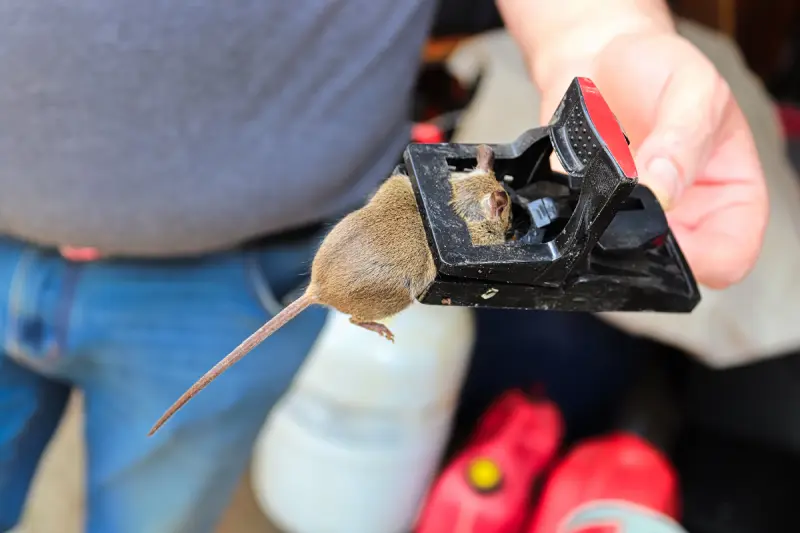
What Does a Mice Exterminator Do?
Question: What does a mice exterminator do?
A professional mice exterminator inspects your property to locate entry points and nesting areas, applies targeted control methods such as baiting and trapping in the right locations, and seals the gaps mice use to get in. Griggs & Browne’s approach is built around exclusion, because removing the current mice without closing entry points only invites the next wave.
How Do You Know You Have Mice? Common Signs in CT Homes
Question: What are the signs of a mouse infestation?
The most common signs are droppings, gnaw marks, and scratching sounds in walls or ceilings at night. In Connecticut homes, activity often concentrates in attics, basements, garages, and kitchens during colder months.
Watch for: – Small dark droppings near food, along walls, or in drawers – Gnaw marks on packaging, wiring, or baseboards – Scratching or scurrying noises inside walls and ceilings after dark – Shredded insulation, paper, or fabric used for nesting – A persistent musky odor in enclosed spaces
Why Mice Are a Problem in Connecticut Homes
Mice are not just a nuisance. They chew through electrical wiring, which is a recognized fire hazard, and they damage insulation, stored food, and belongings. Mice also contaminate surfaces and food with droppings and urine and can spread bacteria and, in the case of some rodents, viruses through their droppings (Source: CDC).
Connecticut’s housing stock adds to the challenge. Many homes across the state are older, with fieldstone foundations, gaps around utility penetrations, and unsealed sill plates that give mice easy access. A mouse can squeeze through an opening roughly the size of a dime, so even a well-kept home can be vulnerable.
Our Connecticut Mouse Control Process
- Inspection Your technician identifies the species, maps entry points, travel routes, and nesting areas, and notes contributing conditions like moisture or clutter.
- Targeted Treatment We place bait stations and traps in the right locations based on the inspection, not randomly, for faster and safer results.
- Exclusion We identify and recommend sealing the gaps, cracks, and utility openings mice use to enter, the single most important step for lasting control.
- Monitoring and Follow-Up For ongoing plans, recurring visits verify the problem is resolved and catch new activity before it escalates.
House Mouse vs Deer Mouse: What CT Homeowners Should Know
Feature | House Mouse | Deer Mouse |
|---|---|---|
Typical location | Urban and suburban homes, kitchens, walls | Rural and wooded properties, sheds, garages |
Appearance | Uniform gray-brown | Brown top, distinct white underside and feet |
Health concern | Contamination, allergens | Higher hantavirus association (Source: CDC) |
CT relevance | Common statewide | Common in wooded and shoreline-edge lots |
Correct identification matters because deer mice, more common on Connecticut’s wooded and semi-rural lots, carry a higher health concern and often require extra care during cleanup.
Why Choose Griggs & Browne as Your CT Mice Exterminator
- Since 1910. Over a century removing rodents from New England homes.
- Exclusion-focused. We seal entry points, not just set traps, so mice stay out.
- Local Connecticut branch. Waterford-based technicians who know regional housing and rodent patterns.
- Licensed and trained. Ongoing certification on safe, effective methods.
- Inspection-first. Every job starts by finding the source, not guessing.
Connecticut customers regularly mention practical, honest help with rodent issues. One Waterford reviewer shared: “While on-site, Shawn was straightforward and truthful. Helped me figure out how to keep mice out of the attic of the house.” (Source: Birdeye, Griggs & Browne Waterford CT)
What Costly Mistake Do Homeowners Make With Mice?
Question: What costly mistake do homeowners make with a mouse problem?
The biggest mistake is treating mice as a one-time nuisance and skipping exclusion. Store-bought traps may catch a few mice, but if the entry points stay open, the infestation returns and often grows. Meanwhile, mice keep chewing wiring, a documented fire risk, and contaminating food. Professional exclusion costs far less than repairing chewed wiring, replacing insulation, or handling a large established infestation later.
How to Keep Mice Out of Your Connecticut Home: Prevention Checklist
Question: How do I prevent mice from getting into my house?
The most effective prevention is sealing entry points and removing food and shelter. Because mice can enter through a gap the size of a dime, small gaps matter. Work through this checklist, especially before fall:
- Seal gaps around pipes, vents, dryer exhausts, and utility lines
- Install door sweeps and repair damaged weatherstripping
- Screen or cap chimneys and foundation vents
- Store pantry and pet food in sealed, hard containers
- Keep firewood and debris away from the foundation
- Declutter garages, basements, and attics that offer nesting sites
- Fix moisture problems that attract rodents and other pests
Exclusion is detailed work, and older Connecticut homes often have many hidden access points. A professional inspection finds the gaps homeowners miss.
DIY Traps vs a Professional Mice Exterminator
Question: Can I get rid of mice myself, or do I need an exterminator?
DIY traps can catch a few mice, but they rarely resolve an established infestation because they do not address entry points or nesting areas. A professional mice exterminator locates the source, treats strategically, and seals access so mice do not return. For anything beyond an occasional single mouse, professional service is usually faster, more thorough, and more cost-effective than repeated DIY attempts.
Factor | DIY Traps | Professional Service |
|---|---|---|
Finds entry points | No | Yes |
Handles infestations | Limited | Yes |
Exclusion / sealing | No | Identified and recommended |
Long-term result | Often temporary | Designed to last |
Key Facts: Mice in Connecticut
- Mice can enter through a gap about the size of a dime.
- A single female house mouse can produce dozens of offspring per year.
- Mice chewing wiring is a recognized fire hazard.
- Deer mice, common on wooded CT lots, carry higher health concern (Source: CDC).
- Fall and winter are peak indoor-intrusion seasons in Connecticut.
Frequently Asked Questions
Timelines vary with the size of the infestation. Initial control often begins right away, and full resolution combines trapping, baiting, and exclusion over one or more visits. We give you a realistic timeline after inspection.
No. Indoors, mice have food, warmth, and shelter, so they stay and reproduce. Active removal plus sealing entry points is what resolves the problem.
Warmth in cold months, accessible food, clutter for nesting, and open entry points around foundations, pipes, and doors. Older CT homes with fieldstone foundations are especially prone.
We use EPA-registered products and place bait in tamper-resistant stations following label safety guidance. Your technician will explain placement and any precautions.
Yes. Attics and wall voids are common CT nesting sites. We locate the activity, treat it, and identify the openings that allowed access.
Light, early infestations may resolve with a focused treatment plus exclusion. Established or recurring problems are best handled with an ongoing plan. We recommend the right fit after inspection.
Connecticut Service Area
Griggs & Browne provides mouse control throughout Connecticut from our Waterford branch, serving New London County and communities across the state. Not sure if we reach you? Call 800-962-3296.
Get Rid of Mice with Griggs & Browne
Do not wait for a few mice to become an infestation. Call Griggs & Browne at 800-962-3296 for a free quote, or contact us online. You get a licensed Connecticut mice exterminator, an exclusion-first process, and more than a century of proven rodent experience.